Translate

Showing posts with label individual. Show all posts

Monday, January 11, 2016

The Civic Balance of Freedom and Responsibility
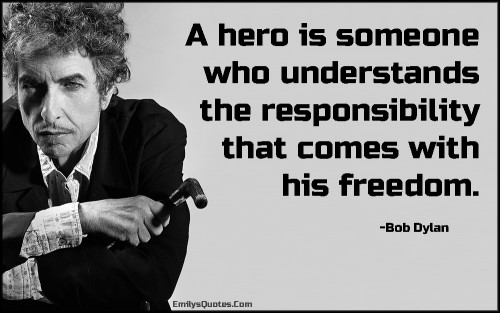
The Civic Balance of Freedom and Responsibility


This week’s The Gowrie News reported the winners of the 26th annual Fort Dodge Noon Sertoma “What Does Freedom Mean to Me?” essay contest. My family has been in a tizzy; we couldn’t be more delighted. The first prize was awarded to Jaiden Ackerson, our eighth-grade granddaughter. Dianna and her daughter, Erin Ackerson, were able to attend the presentation luncheon today (March 7). This week, Jaiden is being recognized as a winner and a hero and has been modestly enjoying her recognition.

Instead of starting with a dictionary definition of “freedom,” Jaiden led off by quoting Bob Dylan: “A hero is someone who understands the responsibility that comes with his freedom.” She went on to say:

Tuesday, July 2, 2013

Essay: Does conservatism inhibit active citizenship?

Information and comments on the essay:


Does conservatism inhibit active citizenship?

From the book: Chum for Thought: Throwing Ideas into Dangerous Waters by David Satterlee

Find out more, including where to buy books and ebooks

Read or download this essay as a PDF file at: https://docs.google.com/file/d/0B4eNv8KtePyKcFB6cXJwYkM0Rlk/edit?usp=sharing

#Democracy #Government


Chum For Thought:
Throwing Ideas into Dangerous Waters

Does conservatism inhibit active citizenship?


It occurred to me a while back that the conservative ideal of “individual freedom,” taken to its logical end, promotes anarchy. If everybody does only what appeals to them as being in the best interests of themselves, their family, or their tribe, it prevents them from fully engaging in the interests of broader civic and societal responsibility. If you are primarily looking out for yourself, you aren’t being a good citizen.

Of course, it also occurred to me that the liberal ideal of “common good,” taken to its logical end, promotes totalitarianism communism… or maybe the kind of selfless love of neighbor that Jesus endorsed. None of these extremes seem practical for America at this point in history.

Isn’t there some balance, some moderate center ground where we can meet and agree to compromise if not find consensus? If you consider American political history during the last few decades, an interesting dynamic appears. It used to be that

Essay: Proactive vs. Reactive – Part 1: Individual and group differences

Information and comments on the essay:


Proactive vs. Reactive – Part 1: Individual and group differences

From the book: Chum for Thought: Throwing Ideas into Dangerous Waters by David Satterlee

Find out more, including where to buy books and ebooks

Read or download this essay as a PDF file at: https://docs.google.com/file/d/0B4eNv8KtePyKbkNtcVZ5U2VVU0k/edit?usp=sharing

#Proactive vs. #Reactive – Part 1: Individual and group differences

Chum For Thought:
Throwing Ideas into Dangerous Waters

Proactive vs. Reactive – Part 1
Individual and group differences

Isn’t it encouraging to meet someone who takes pride in doing their job well? I’ve met several such gems recently here in town. 

Do you know someone like this? Tell them that you noticed. Even if it’s not the same person that I had in mind, the one you compliment will receive that positive recognition from you. You can make their day. My most recent contact made the comment that they “believe in being proactive rather than reactive.”

A person who is only REactive waits for something to happen and then responds to that event. A person who is PROactive takes initiative to make change happen, anticipates potential threats or opportunities, and takes steps ahead of time to be prepared. Things seem to go better for proactive people. The reason is explained by the saying, “Good luck is found at the intersection of preparation and opportunity.”

As individuals, we have an advantage over lower life forms. A bacterium may simply react by moving toward food or away from an irritating chemical. In fact, when there are no

Essay: Communities and their essential limits on personal freedom

Information and comments on the essay:


Communities and their essential limits on personal freedom

From the book: Chum for Thought: Throwing Ideas into Dangerous Waters by David Satterlee

Find out more, including where to buy books and ebooks

Read or download this essay as a PDF file at: https://docs.google.com/file/d/0B4eNv8KtePyKTkF5N0Q0WmRzZGc/edit?usp=sharing

Communities are inherently intrusive, coercive, and very necessary


Chum For Thought:
Throwing Ideas into Dangerous Waters

Communities and their essential limits
on personal freedom


“No man is an island.” Communities are the foundation of civilization. It is almost impossible to be entirely self-sufficient. We need each other for our variety of abilities, interests, and ideas. Our individual differences make us stronger as a group.
Farmers understand that monoculture crops require extra care because they are more vulnerable to disease and disaster. Colonies of single-cell bacteria do not need diversity in the same way because they just reproduce rapidly to consume whatever they find and then die back.
For people, it is easiest to create communities when everyone shares mostly the same values. But, the more we isolate ourselves from others who are different in some way, the more extreme, intolerant, and fragile, our group becomes.
In the natural environment, thousands of