Translate

Monday, April 4, 2016

Jobs: Part 2: Disintermediation

Jobs: Part 2: Disintermediation

Whatever happened to all the travel agents, filling station attendants, and encyclopedia salesmen? It turns out they were middlemen – intermediaries between you and what you wanted. Therefore, you can say that, when we found ways to do their jobs more directly, they were “disintermediated.”

These days, it is ever-more-common to “cut out the middleman.” You book your own travel, pump your own gas, and easily search for information about any subject that interests you by using Internet search engines. The Encyclopedia Britannica has stopped printing paper volumes. Voluntary curators and editors contribute articles to Wikipedia, a free on-line encyclopedia with an increasingly solid reputation. Tesla Motors is working toward their vision of bypassing dealerships to sell electric automobiles directly to the public.

Monday, March 28, 2016

Jobs-Part 1: Automation

Jobs-Part 1: Automation

Whatever happened to all the elevator operators, telephone switchboard operators, cabbage pickers and tollbooth collectors? These and many thousands of other jobs have been eliminated by automation technology. On the bright side, we can now directly dial almost any phone in the world and not have to worry about watching our seconds on long distance calls. But, these are jobs, for you and your neighbors, that will never come back.

Our losing so many jobs to machines is not the end of the world or the end of work, but it is traumatic. The changing nature of work (and availability of jobs) will create some economic challenges. You see senior citizens sacking groceries when they would rather be holding their grandbabies or nursing their bunions. You see college graduates assembling grease-burgers (hold the ketchup) when they would rather be building their families and paying off their student loans.

We’ve gone through this before. Whatever happened to tanners, weavers, cobblers, and blacksmiths? Those were the days of craftsmen, apprentices, and hand-carved ornamentation on furniture. You could tell who had made a piece by the personal touches in its design. You took care of what you owned because you knew that years of experience, hours of labor and, sometimes, sweat and blood went into its production.

Monday, March 7, 2016

The NRA Speaks Out Against Packing Heat

The NRA Speaks Out Against Packing Heat

It may surprise you to discover that the National Rifle Association has recently strayed quite far from its traditional moderate views to embrace much more radical policies. For instance, the position of the NRA on carrying guns in public has changed over time.

Has the leadership of the NRA embraced the developing maturation of American social conscience, or have they been lured to pander to the interests of weapon manufacturers? I usually try to resist cut-and-paste columns, but I want to offer some cherry-picked quotations drawn from “academic histories of the NRA” for your consideration.

“I have never believed in the general practice of carrying weapons. I do not believe in the general promiscuous toting of guns. I think it should be sharply restricted and only under licenses.” - NRA President Karl T. Frederick, praising state gun control laws when he testified in Congress before the 1938 federal gun control law passed.

Monday, February 29, 2016

Research: Does Conservative Negativism Repress Rational Thought?

Research: Does Conservative Negativism
Repress Rational Thought?

Conservatives are fond of identifying “enemies” and using strong negative words and images to describe them. I wrote about this in the essay Conservatives Depending on Emotional Words to Persuade where excerpts of a GOP memo from Newt Gingrich suggest words to describe “our opponents” including: failure, pathetic, lie, liberal, betray, hypocrisy, radical, etc.

Psychologists have already discovered that emotions affect higher brain functions including attention, memory, vision and motor control. Now, researchers are discovering that negative language inhibits the lower level retrieval of knowledge and subconscious information processing. A Bangor University study initially expected that negative emotional words would be arousing and stimulate reasoning capacity. Instead, they found that negative words suppressed certain cognitive responses.

I suggest that combining these two observations may show that repeatedly describing liberals [or another race, or immigrants, or non-believers] in negative terms may reduce the audiences’ ability to reason critically about the information they are receiving.

Monday, February 22, 2016

Speech: Superman is a Liberal

Speech: Superman is a Liberal

Shutterstock
In the United States, there are two major political parties that spring from two very different general inclinations. Both of these dispositions offer some benefits. They serve important and legitimate purposes for individuals and the American citizenry as a whole. However, these impulses work best in balance. 

That is also to say that both conservatives and liberals (at their radical extremes) are damaging. This country works best when all sides work to find a middle way – a balanced common ground that produces the greatest possible common good while still allowing the greatest possible individual liberty.

The terms liberty and freedom should not be misapplied. The privilege of personal choice cannot be separated from the obligation to public responsibility. Personal beliefs cannot be forced upon unwilling others. Internal thoughts and values are private. External acts are subject to limitations within a community.We defend personal liberties and freedoms up to the point that they tread on the personal liberties and freedoms of others. In this way, we create communities of common good and protect justice for all.

Monday, February 15, 2016

Choosing Your Values, Virtues, Vices and Sins

Choosing Your Values, Virtues, Vices and Sins

I want to thank all of you who have followed my last few months of political commentary. We have especially explored the differences between those who are uncomfortable with change and those who can face it with hope as an opportunity to improve matters – those who fear the risk of losing what they have and those who have the faith to work with strangers to achieve what they cannot do by themselves.

Values and virtues underlie our private and public choices. And, I want to move on to thinking about what makes us decide that something is good or bad and then choose what we will or won’t do. This column is about to make a shift. I thought a little fair warning was in order. Here we go…

Monday, February 8, 2016

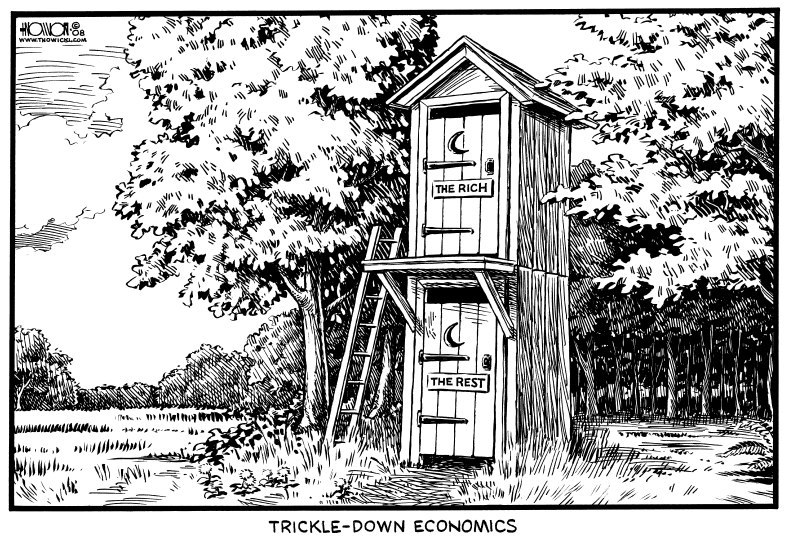
Debunking Trickle-down Economics

Debunking Trickle-down Economics

In 1896, William Jennings Bryan declared that, “There are two ideas of government. There are those who believe that if you just legislate to make the well-to-do prosperous, that their prosperity will leak through on those below. 
The Democratic idea has been that if you legislate to make the masses prosperous, their prosperity will find its way up and through every class that rests upon it.” Later, Lyndon B. Johnson added, in his brutally blunt style: "Republicans [...] simply don't know how to manage the economy. They're so busy operating the trickle-down theory, giving the richest corporations the biggest break that the whole thing goes to hell in a hand basket."

This economic idea of “trickle-down” dates back to the earlier horse-and-sparrow aphorism: “If you feed the horse enough oats, some will pass through to the road for the sparrows.” In our time, it was formally called “supply side economics.” Ross Perot called it “political voodoo.” Whatever you call it, it has been a dominant political policy priority in many governments and corporations for a long time. But, a metaphor producing an easily-visualized image does not make it an apt model of reality.

Monday, February 1, 2016

In Defense of Plagiarism

In Defense of Plagiarism

I own a fascinating collection of treatises on plagiarism in the volume Perspectives on Plagiarism and Intellectual Property in a Postmodern World published by State University of New York Press. Beginning on page xv, the Introduction makes the point:

“Plagiarism is perceived as a problem but it is often discussed in simplistic terms: "using someone else's words without telling whose they are or where you got them"; "stealing other people's ideas or words." This basic view of plagiarism comes directly from the Latin source of the word, which meant to kidnap a person, referring only to children or servants or slaves: people who could in some sense be owned... 

A postmodern perspective of plagiarism and intellectual property suggests that one cannot own ideas or words. All we can do is honor and recompense the encoding of those ideas...”

I note (with considerable interest) that these editors, themselves, did not hesitate to simply enclose particularly apt phrases in quotes and move on.