Translate

Tuesday, July 2, 2013

Essay: Setting limits

Information and comments on the essay:


Setting limits

From the book: Chum for Thought: Throwing Ideas into Dangerous Waters by David Satterlee

Find out more, including where to buy books and ebooks

Does Setting limits cause #isolation, loss of #intimacy, and even #alienation of #love?


Chum For Thought:
Throwing Ideas into Dangerous Waters
Women often feel at a disadvantage in relationships with men. Social pressures, openly or unrecognized, can give men a dominant role. How is a woman to feel self-respect, personal worth, independence, initiative, control, and security? The common answer, these days, is to “set limits.”

Setting defensive limits makes intuitive sense. “That which cannot touch you cannot harm you.” But, at what cost in isolation, loss of intimacy, and even alienation of love? In fact, the issue of boundaries and limits can affect the character of any relationship, not just those between men and women.

Kinds of Limits

Parents and teachers are urged to set firm, appropriate limits for young children as part of youths’ guided moral development. The goal is for children to

Essay: Eastern influences on contemporary Western culture and spirituality

Information and comments on the essay:


Eastern influences on contemporary Western culture and spirituality

From the book: Chum for Thought: Throwing Ideas into Dangerous Waters by David Satterlee

Find out more, including where to buy books and ebooks

Read or download this essay as a PDF file at: https://docs.google.com/file/d/0B4eNv8KtePyKY0djTlVOMDJQR1E/edit?usp=sharing


Chum For Thought:
Throwing Ideas into Dangerous Waters


Eastern influences on contemporary Western culture and spirituality


Many people in Western cultures have become aware of, and adopted elements of, traditional Eastern religions to a variety of degrees. Although usually ignorant of, or rejecting the full scope of the associated original foundational historical practice and philosophy, they are creating a new flavor of Western spirituality and a related social consciousness.

Both Eastern practitioners and Western philosophers have helped raise our general consciousness of Eastern spiritual traditions over the last century. Some of the more prominent are briefly described in the following:
William James, a leading psychologist and philosopher published The Varieties of Religious Experience in 1902. This helped introduce Eastern religious thought to the West.

 Aldous Huxley’s 1945 The Perennial Philosophy identifies a recurring insight of divine reality that is common to most primitive peoples and all

Essay: Japan, America, and sacred nationalism

Information and comments on the essay:


Japan, America, and sacred nationalism

From the book: Chum for Thought: Throwing Ideas into Dangerous Waters by David Satterlee

Find out more, including where to buy books and ebooks

Read or download this essay as a PDF file at: https://docs.google.com/file/d/0B4eNv8KtePyKZkxRVW9jSWpsZVk/edit?usp=sharing


Chum For Thought:
Throwing Ideas into Dangerous Waters

Japan, America, and sacred nationalism


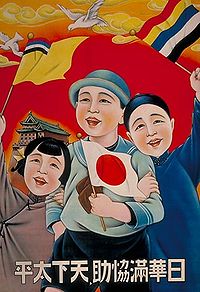
The Japanese islands have remained relatively isolated throughout their history. This has allowed for the development and concentration of distinctive religious and cultural characteristics. Although Japan has experienced Eastern influences (mostly Chinese and Buddhism), and Western influences (especially Anglo/American and Christian), these have seemed to only flavor, not disrupt, the Nipponese sense of identity. This bears a strong resemblance to contemporary American right-wing conservatism.

From the most ancient times, Japan, and its Shinto practices have been organized around community-clans and their respective clan gods. Even when communities gradually expanded, community worship continued to revolve around local guardian gods and the ancestors of extended families. Broader political power was rooted in the relationships of confederations of clans. This religio-cultural structure made it unlikely that religions of foreign origin could have much impact and still remain intact. This system retained a stable core of abiding traditions, supplemented by a somewhat more adaptive layer of minor local traditions.

As an example, Buddhism, when promoted by certain nobles, was assimilated in Japan by

Essay: Confucius, Emerson, and Ginsberg

Information and comments on the essay:


Confucius, Emerson, and Ginsberg

From the book: Chum for Thought: Throwing Ideas into Dangerous Waters by David Satterlee

Find out more, including where to buy books and ebooks

Read or download this essay as a PDF file at: https://docs.google.com/file/d/0B4eNv8KtePyKX0N1cTNqMTY1N2c/edit?usp=sharing
Chum For Thought:
Throwing Ideas into Dangerous Waters


Confucius, Emerson, and Ginsberg


The classic tenants of Confucianism and Taoism take disparate, but not mutually-exclusive, views of existence. While only Confucians would seek to give advice for improving society, elements of both views are important to a balanced and healthful existence within a society.

Confucianism is all about improving society. Individuals are expected to yield to established laws and the greater good of the community. The fundamental concept for maintaining society is the competence and fairness of public servants, which earns respectful honor and loyalty (for others, family, ancestors, public servants, and tradition). Law and tradition are looked to for guidance. The Stanford Encyclopedia of Philosophy explains:
Confucius' social philosophy largely revolves around the concept of ren, “compassion” or “loving others.” Cultivating or practicing such concern for others involved deprecating oneself. … Learning self-restraint involves studying and mastering li, the ritual forms and rules of propriety through which one expresses respect for superiors and enacts his role in society in such a way that he himself is worthy of respect and admiration. A concern for propriety should inform

Essay: Is self-denial good for you?

Information and comments on the essay:


Is self-denial good for you?

From the book: Chum for Thought: Throwing Ideas into Dangerous Waters by David Satterlee

Find out more, including where to buy books and ebooks

Read or download this essay as a PDF file at: https://docs.google.com/file/d/0B4eNv8KtePyKNG1fWXZETTNDR00/edit?usp=sharing

#Hindu #Buddhist #Saints

Chum For Thought:
Throwing Ideas into Dangerous Waters


Is self-denial good for you?


Asceticism is the voluntary and deliberate self-denial of personal comforts and possessions. It is usually undertaken to distance oneself from the distractions of material or interpersonal responsibilities. This is often with the explicit purpose of devoting time and attention to transcendental spiritual pursuits.

Asceticism is relatively common among the most devout adherents of many religions. Mormon missionaries temporarily defer marriage, career, and family associations for at least two years during their missions. Missionaries of other religions, usually live according to the impoverished standards of the community to which they are sent.

Religions with special orders of devotion may distinguish individuals who take vows of poverty, celibacy, and obedience. They may live cloistered lives of isolation or give exclusive attention to assigned duties. Volunteer workers at the branch offices of Jehovah’s Witnesses take such vows as do many priests, monks, and nuns.

Individuals such as Hindu and Jain ascetics usually have reached a point of spiritual development that

Essay: Walking with the flow of Tao in a modern world

Information and comments on the essay:


Walking with the flow of Tao in a modern world

From the book: Chum for Thought: Throwing Ideas into Dangerous Waters by David Satterlee

Find out more, including where to buy books and ebooks

Read or download this essay as a PDF file at: https://docs.google.com/file/d/0B4eNv8KtePyKSVRLUURhMFdlWkE/edit?usp=sharing

Chum For Thought:
Throwing Ideas into Dangerous Waters


Walking with the flow of Tao in a modern world


The Chinese character for Tao combines two signs: head and foot. It reflects the concept of walking consciously. It is simply “the way” and implies that the walker is in conscious harmony with the existing order of things. His/her actions are intentionally harmonious rather than in conflict or opposition to what is. The way of Tao tends to rely more on sensitized intuition rather than reasoning and logic.

The practical application of Tao-living leads to competences that Westerners would consider “giftedness.” For instance, an archer living with Tao would not attempt to mentally calculate trajectories and influences of a cross breeze, but would experience a sense of fullness with his environment, visualizing the arrow’s destination. He would release his arrow toward the target when the moment and position seemed right. Skilled basketball players (or golfers, etc.) can have the same reflexes for making good shots or right moves. Many of us feel the same sense of effortlessness while driving in traffic.

The research psychologist Mihaly Csikszentmihalyi describes a similar state of mind that he calls “flow.” Flow may occur while

Essay: Implications of the Buddhist “no-self” concept

Information and comments on the essay:


Implications of the Buddhist “no-self” concept

From the book: Chum for Thought: Throwing Ideas into Dangerous Waters by David Satterlee

Find out more, including where to buy books and ebooks

Read or download this essay as a PDF file at: https://docs.google.com/file/d/0B4eNv8KtePyKVkQtc28tcVJjX0k/edit?usp=sharing

Hindu #Buddhist #Saints


Chum For Thought:
Throwing Ideas into Dangerous Waters


Implications of the Buddhist “no-self” concept


The Hindu concept of atman is the indestructible essential self, which is reincarnated in a series of corporeal physical existences.

The Buddhist concept of “an-atman” (or no-atman) refutes the idea of an irreducible unitary essence that sustains an existence. An-atman presumes total dissipation at death and rebirth as a new constitution from previous cause.

The implication of an-atman is that no thing or person is special. Wealth accumulated for the sole benefit of self or favored others is meaningless because we are not only related to all else, but are nothing but “all else.”

With the distinction of all things and selves being illusion, there is no need to cling or grasp for anything desired but perceived to be unobtained. In fact, the desire for things-not-had defines the dukkha (“suffering”) of the human condition.

Since the accumulation of ever-increasing possessions and the

Essay: Hindu class systems vs. cultures and communities in general

Information and comments on the essay:


Hindu class systems vs. cultures and communities in general

From the book: Chum for Thought: Throwing Ideas into Dangerous Waters by David Satterlee

Find out more, including where to buy books and ebooks

Read or download this essay as a PDF file at: https://docs.google.com/file/d/0B4eNv8KtePyKdjE4dk5wX2s0QVk/edit?usp=sharing

    Chum For Thought:
    Throwing Ideas into Dangerous Waters

    Hindu class systems vs. cultures and communities in general


    Some, feeling that they lack any interest in Eastern religions, may have the impulse to skip this one. They would miss a thought-provoking exercise in comparing and contrasting that could be very relevant to their own communities and values.

    The traditional Hindu class system is anchored in sacred scripture, and many generations of tradition. Hinduism, in part, defines itself by compliance to class distinctions, and so Hinduism fits very coherently with the class system of India. Class systems are common in most religious and cultural systems, including contemporary America.

     In Hinduism, the separation of groups helps to maintain ritual purity. An unclean interaction in society can prevent a higher class member from performing their ritual responsibilities in behalf of others. Each class (varna) has its defined and accepted role (dharma). For instance, sacred learning, community rites, and sacrifice are reserved for the Brahman (priestly) class.

    Other Hindu religious classes are defined according to societal place. The warrior class (Kshatriya) serves for defense and administration. Producers (Vaishya) are responsible as businessmen, merchants, and for higher crafts. Menials (Shudra) provide